


Overview
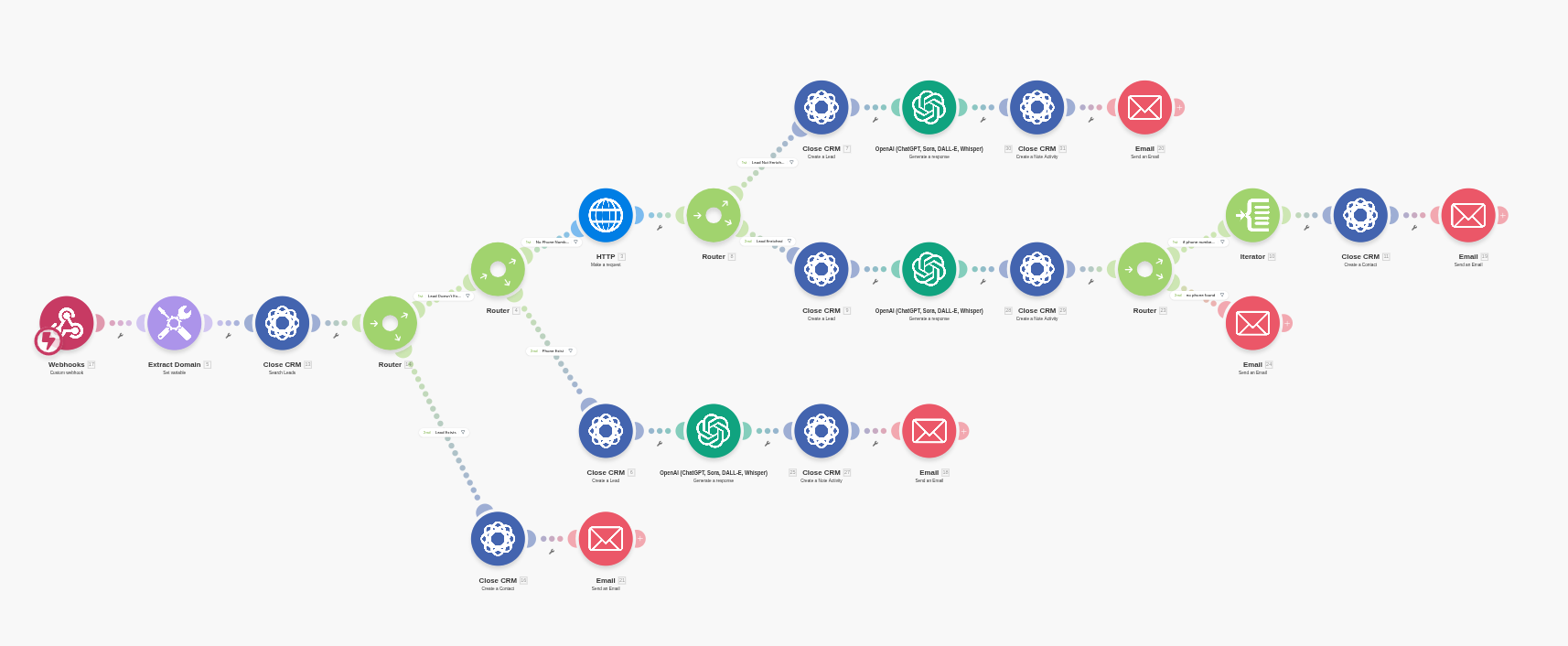
This document outlines a production-grade AI-powered automation built for client by helt.partners. The goal was to dramatically improve the conversion rate of inbound leads by reducing response time and increasing the quality of first-touch outreach.
Problem Statement
client generates a significant volume of warm inbound leads through its website. These leads are highly valuable because:
- They have already expressed intent
- They are actively evaluating solutions
- They are most responsive immediately after submission
However, several structural problems reduced conversion rates:
1. Slow Response Time
Leads were not being contacted quickly enough after submission. This is critical because:
- Lead intent decays rapidly
- Competitors may engage first
- Delay reduces booking probability significantly
2. Suboptimal SDR Performance
While client had internal sales processes, their conversion rates were lower compared to helt.partners' SDR team.
3. CRM Fragmentation
All inbound leads were stored inside client’s CRM, but:
- The outbound calling team (helt.partners) operated in Close CRM
- There was no seamless way to transfer leads in real-time
4. Missing Contact Data
Many leads submitted forms without phone numbers, making immediate outreach impossible.
Strategic Objective
The objective was not just automation—it was conversion optimization through speed, enrichment, and AI-assisted execution.
Specifically:
- Capture inbound leads instantly
- Transfer them to the correct execution environment (Close CRM)
- Ensure every lead is call-ready within seconds
- Equip SDRs with AI-generated context and scripts
- Trigger immediate action
Solution Architecture
We designed a real-time automation pipeline using Make (formerly Integromat), integrating:
- Webhooks (lead ingestion)
- Close CRM (lead management)
- Lusha API (data enrichment)
- OpenAI (script generation)
- Email notifications (execution trigger)
The system ensures that every inbound lead is processed, enriched, structured, and actionable within seconds.
Step-by-Step Automation Breakdown
1. Webhook Trigger – Lead Capture
Trigger: A user submits a form on client’s website.
- A webhook is fired instantly
- Payload includes:
- Name
- Company
- Product interest
- Reason for interest
Why this matters:
- Eliminates polling or delays
- Enables real-time processing
2. Domain Extraction
- The system extracts the domain from the email address
- Example:
john@company.com → company.com
- Example:
Why this matters:
- Domain acts as a unique company identifier
- Prevents duplicate company creation
- Enables accurate CRM matching
3. CRM Lookup (Close CRM)
- The system searches Close CRM for an existing lead using the domain
Two possible outcomes:
Case A: Lead Exists
- Create a new contact under the existing company
Case B: Lead Does Not Exist
- Create a new lead (company) using the domain
Why this matters:
- Maintains CRM hygiene
- Avoids duplication
- Preserves account-level context
4. Phone Number Check
- The system checks whether the submitted form includes a phone number
If phone number exists:
- Proceed directly
If missing:
- Trigger enrichment via Lusha API
Why this matters:
- Calling is the primary conversion channel
- Missing phone numbers = lost opportunities
5. Data Enrichment (Lusha)
-
The system queries Lusha using:
- Domain
-
Retrieves:
- Direct phone numbers
- Additional contact data
Why this matters:
- Converts non-callable leads into callable ones
- Increases reachable lead volume
6. Contact Creation in Close CRM
- A fully enriched contact is created or updated in Close CRM
Includes:
- Name
- Phone number (original or enriched)
- Company association
Why this matters:
- Ensures SDRs have complete, actionable records
7. AI Call Script Generation (OpenAI)
- The system generates a custom call script using:
- Lead’s stated interest
- Product context
- Reason for inquiry
Output includes:
- Opening hook
- Value proposition
- Key talking points
- Objection handling cues
Why this matters:
- Reduces SDR preparation time to near zero
- Standardizes quality of outreach
- Personalizes every interaction
8. CRM Note Creation
- The generated script is saved as a note inside Close CRM
Why this matters:
- Keeps all context centralized
- Enables SDRs to act without switching tools
9. SDR Notification
- An automated email is sent to the responsible SDR
Includes:
- Lead details
- Context
- Urgency to act immediately
Why this matters:
- Creates instant accountability
- Drives rapid follow-up
- Aligns behavior with inbound urgency
System Flow Summary
- Lead submits form → webhook triggered
- Domain extracted from email
- CRM checked for existing company
- Lead/contact created accordingly
- Phone number validated or enriched via Lusha
- Contact finalized in Close CRM
- AI generates tailored call script
- Script saved as CRM note
- SDR notified instantly
Key Design Decisions (and Why They Matter)
Real-Time Processing vs Batch
We chose real-time automation because:
- Speed directly correlates with conversion
- First contact advantage is critical
Domain-Based Matching
Instead of relying on names:
- Domains provide higher accuracy
- Prevent duplicate companies
AI at the Point of Execution
AI is used right before the call, not earlier
Reason:
- Maximizes relevance
- Uses freshest data
- Reduces wasted computation
Enrichment as a Conditional Step
Lusha is only triggered when needed
Reason:
- Reduces cost
- Improves efficiency
CRM-Centric Workflow
All outputs are stored in Close CRM
Reason:
- Keeps SDR workflow frictionless
- Avoids tool switching
Business Impact
This automation transforms inbound lead handling from:
Slow, fragmented, and inconsistent
→ into
Instant, enriched, and execution-ready
Expected Outcomes
- Faster lead response times (seconds vs hours)
- Higher contact rates
- Improved meeting booking rates
- Better SDR performance consistency
Positioning as an AI Automation Use Case
This system is not just integration—it is:
A conversion infrastructure layer that combines real-time data flow, enrichment, and AI-assisted execution.
It demonstrates how an AI automation agency can:
- Bridge disconnected systems
- Enhance human performance with AI
- Turn inbound demand into revenue faster
Final Takeaway
The core insight behind this system is simple but often ignored:
The value of a lead is highest the moment it is created.
This automation ensures that moment is never wasted.