


Overview
This document outlines an automation built by Helt Partners to eliminate post-call bottlenecks for SDRs and significantly increase outreach throughput without increasing headcount.
Problem Statement
SDRs were spending disproportionate time on post-call tasks instead of engaging new prospects.
Baseline Workflow
After a short call (~5 minutes), the SDR had to:
- Re-listen to the full recording
- Extract key points and context
- Manually draft a follow-up email
Average time per follow-up: ~20 minutes
Constraint
With ~4 hours allocated to calling + follow-ups:
- Only ~12 customers could be handled
This created a hard ceiling on productivity and slowed pipeline velocity.
Objective
- Reduce follow-up time per call
- Maintain or improve quality of communication
- Increase total number of customers reached per day
Solution Architecture
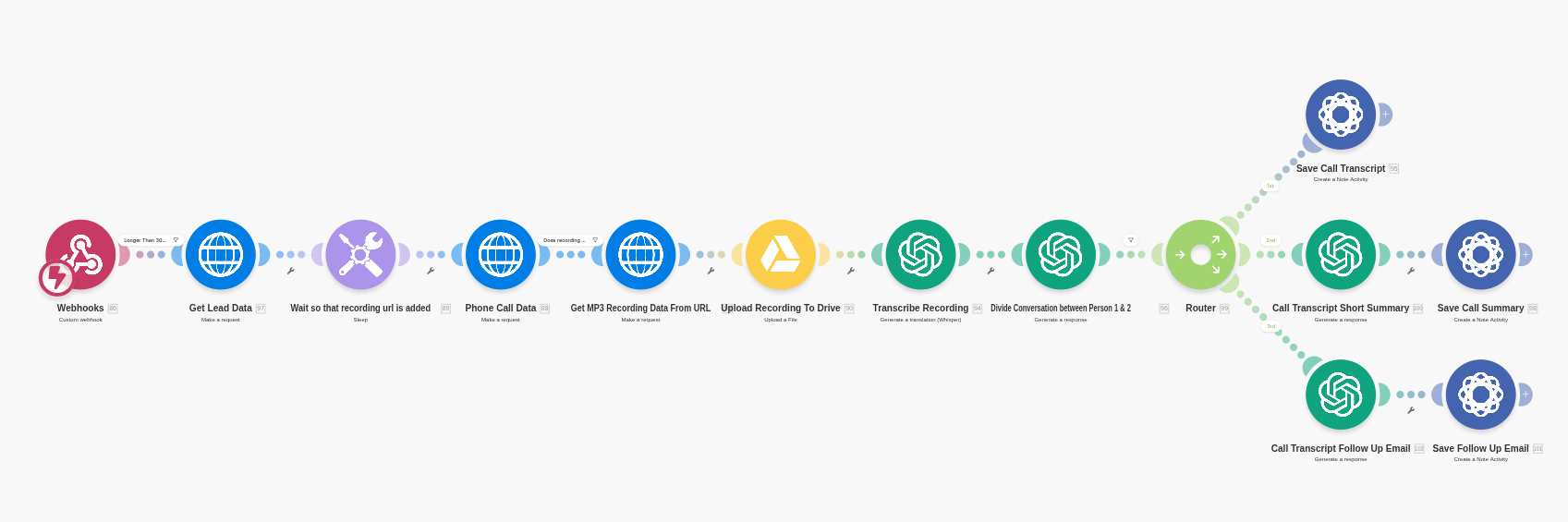
A real-time automation pipeline built in Make, integrating:
- Close CRM (lead data)
- Call recording APIs (audio retrieval)
- Google Drive (storage)
- OpenAI (transcription + generation)
Automation Flow
Step-by-Step Breakdown
1. Trigger on Call Completion
- Automation runs immediately after an SDR finishes a call
2. Call Qualification Filter
- Only process calls longer than 30 seconds
Rationale: Filters out missed calls and non-meaningful interactions
3. Retrieve Lead Data (Close CRM)
- Pull contact and company data via API
Rationale: Grounds AI outputs in CRM context and links results to the correct record
4. Fetch & Store Recording
- Download call recording (MP3)
- Upload to internal Google Drive
Rationale: Centralized storage for auditability and future reference
5. Transcription & AI Processing
- Transcribe the call
- Pass transcript to AI for structured outputs
6. Generate Outputs
a) Call Summary
- Key points discussed
- Customer intent
- Agreed next steps
b) Follow-Up Email
- Context-aware and personalized
- Ready-to-send format
Rationale: Eliminates manual review and standardizes quality
7. Save to CRM
- Summary and draft email are stored in Close CRM
Rationale: Keeps SDR workflow in a single system (no tool switching)
8. SDR Action
- SDR reviews generated content
- Sends follow-up immediately
System Logic Summary
- Call ends → trigger automation
- Filter for calls > 30s
- Pull lead data from CRM
- Fetch & store recording
- Transcribe via AI
- Generate summary + follow-up email
- Save outputs in CRM
- SDR reviews and sends
Business Impact
Before
- ~20 minutes per follow-up
- ~12 customers per 4-hour block
After
- ~5 minutes per follow-up
- Up to 48 customers per 4-hour block
Key Insight
The primary bottleneck wasn’t calling—it was post-call processing.
By removing that friction, Helt Partners effectively:
4x increased SDR output without increasing headcount
Strategic Takeaway
Scaling sales is not just about adding more people.
Eliminating hidden time sinks unlocks exponential throughput gains.
This system converts time lost in admin into time spent generating revenue.